
Ä¢¹½¶ÌÊÓƵ Offering New Auto Body Certifications
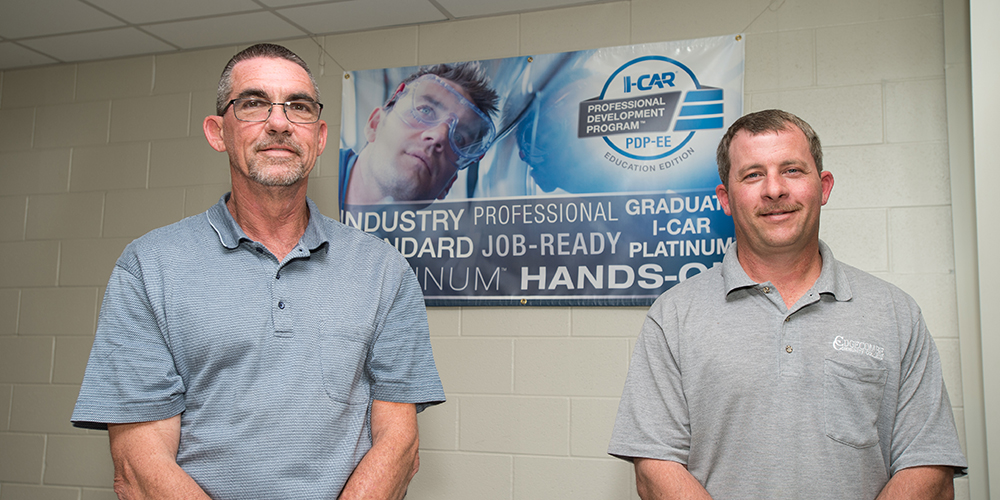
This fall semester, Ä¢¹½¶ÌÊÓƵ will be the first community college in the Edgecombe area to offer students I-CAR certifications through its Collision Repair and Refinishing Technology program. Bud Speight (left), program chair, and Kevin Strickland, instructor, will lead the advanced training.
A quick internet search shows that auto body repair and collision jobs are readily available both locally and nationwide. With advanced certification offered at Ä¢¹½¶ÌÊÓƵ, job seekers can write their own ticket.
According to Bud Speight, program chair of at Ä¢¹½¶ÌÊÓƵ, “Our graduates are guaranteed employment if they walk out of here with a Pro Level 1 Platinum certification. And that certification is going to get them higher wages.â€�
This fall, Ä¢¹½¶ÌÊÓƵ will be the first community college in the Edgecombe area to offer students this advanced certification through the College’s I-CAR curriculum. I-CAR, Inter-Industry Conference on Auto Collision Repair, is an international organization that provides information, knowledge, and skills required to perform complete, safe, and quality repairs.
I-CAR serves all segments of the collision repair industry: collision repair; insurance; original equipment manufacturers; education, training and research; tools, equipment and supply; and related industry services.
This summer, Speight completed extensive training to become a certified Pro Level 1 Platinum instructor. Ä¢¹½¶ÌÊÓƵ instructor Kevin Strickland anticipates earning instructor certification by the start of fall semester.
“I-CAR offers numerous certifications, and by merging their curricula with what is already in place here at Ä¢¹½¶ÌÊÓƵ, our students will earn industry-standard I-CAR certifications while they achieve Ä¢¹½¶ÌÊÓƵ credentials,â€� Speight explains.
The College’s program is unique in the region. The closest similar programs are at Wayne Community College and Fayetteville Technical Community College.
Students in the program at Ä¢¹½¶ÌÊÓƵ can opt for a two-year degree, one-year diploma, or numerous certificates. The program is housed in a 7,000-square-foot state-of-the-art facility that features virtual reality technology, a dustless sanding system, and a compartmentalized sandblaster.
Part of the overall goal of the program is for students to gain I-CAR certifications in their classes. As Speight explains, “For every certification, students earn I-CAR points. They carry these points with them when they go to work at auto body shops, and the shops have to reach a certain level of I-CAR points among their technicians in order to gain insurance work.�
Auto body shops also may benefit by sending their technicians to Ä¢¹½¶ÌÊÓƵ for I-CAR training and certifications.
Speight says that his Advisory Board was instrumental in the College’s decision to seek I-CAR credentials. Ä¢¹½¶ÌÊÓƵ advisory boards are in place for about thirty Ä¢¹½¶ÌÊÓƵ academic programs. The boards consist of professional leaders and community members who are experts in their field.
“My advisory board has been pushing for I-CAR, and I’m grateful for their guidance,� he explains. “They understand better than anyone the demands of the industry since they work in it every day.�
In addition to Ä¢¹½¶ÌÊÓƵ credentials, students can earn Pro Level 1 Platinum certification in non-structural repair and painting and refinishing. “To reach the platinum level, students will have multiple I-CAR certifications,â€� Speight says.
According to the Bureau of Labor Statistics, auto body and repair employment is expected to grow by 8 percent over the next seven years. Presently, technicians earn about $41,000 a year on average, and Speight says that salary can double or more with advanced I-CAR certifications.
“Body shop owners tell me that if I can provide graduates with platinum certification, they’ve got a job,� Speight adds. “Our graduates can make very good money, if they put in the effort.�